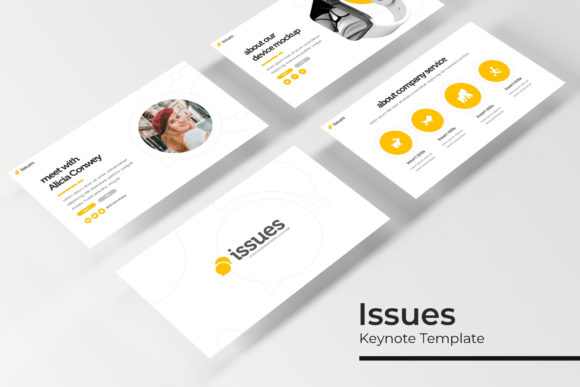
Issues Keynote Template: A Strategic Framework for Visual Communication
The Issues Keynote Template is more than a collection of aesthetically pleasing slides; it is a comprehensive visual infrastructure designed to streamline high-stakes communication. For entrepreneurs, marketers, and decision-makers, the primary value lies not in the decoration but in the structural capacity to organize complex narratives efficiently. With 150 total slides distributed across five distinct premade color variations, this asset provides a modular system for addressing diverse business needs without starting from scratch. Strategically, utilizing such a robust template allows professionals to bypass the initial friction of design and focus immediately on message architecture, ensuring that critical issues are presented with clarity and authority.
In an era where attention is scarce and cognitive load is high, the ability to present information through handcrafted infographics and pixel-perfect illustrations serves a functional purpose beyond mere engagement. These visual elements act as cognitive anchors, helping audiences retain key data points and understand relationships between disparate ideas. When you leverage the Issues Keynote Template, you are effectively deploying a pre-validated communication framework. The inclusion of section break slides, gallery layouts, and portfolio slides suggests a versatility that extends beyond standard reporting. Whether positioning a new product, educating stakeholders on operational changes, or pitching creative services, the template offers specific environments tailored to different modes of persuasion and information transfer.
Aligning Visual Assets with Strategic Objectives
Before opening any of the five included PPTX files, it is essential to define the strategic intent behind the presentation. A common failure mode in professional communication is selecting a template based solely on aesthetic preference rather than functional alignment. The Issues Keynote Template offers five color variations, each containing 30 unique slides. This segmentation should be viewed as a toolkit for different contextual scenarios rather than just stylistic choices. For instance, one color palette may convey the stability required for financial reporting or operational audits, while another might possess the vibrancy necessary for marketing campaigns or creative pitches.
Decision-makers must evaluate which of the five variations best supports their current objective. If the goal is to secure buy-in for a sensitive internal issue, a muted, structured variation utilizing the master slide layouts can project seriousness and control. Conversely, if the aim is to showcase innovation or attract new clients, the more dynamic infographic slides and resizable graphic placeholders become primary assets. By mapping the template’s features to specific business outcomes—such as improved stakeholder understanding, faster approval cycles, or enhanced brand perception—you transform a generic design file into a targeted strategic instrument. This intentionality prevents the presentation from feeling disjointed and ensures every slide serves the broader narrative goal.
Leveraging Modular Design for Operational Efficiency
Productivity in presentation development is often sacrificed at the altar of customization. The Issues Keynote Template addresses this trade-off through its drag-and-drop functionality and master slide architecture. For small business owners and freelancers operating with limited resources, time spent adjusting alignment or sourcing icons is time diverted from core business activities. The template’s editable picture placeholders and resizable graphics allow for rapid iteration without compromising visual integrity. This modularity is particularly valuable when dealing with evolving issues where data or messaging may change up until the moment of delivery.
The practical application of this efficiency extends to team collaboration. Because the template is built on master slides, multiple contributors can work within the same ecosystem without breaking the visual language. This consistency is crucial for maintaining brand coherence across departments. When a marketing team uses the portfolio slides to highlight campaign successes and an operations team uses the infographic slides to detail process improvements, the underlying unity reinforces organizational professionalism. Furthermore, the inclusion of free font download links in the readme file eliminates technical friction during handoffs, ensuring that the file renders correctly regardless of who opens it. This attention to technical detail supports smoother workflows and reduces the risk of formatting errors that can undermine credibility in high-pressure meetings.
Navigating Content Strategy with Pre-Built Structures
The sheer volume of 150 slides can be overwhelming if approached linearly. Instead, treat the Issues Keynote Template as a non-linear library of narrative components. Effective use requires curating only the slides that advance your specific argument. The section break slides serve as vital pacing mechanisms, allowing you to segment complex topics into digestible chapters. In educational or training contexts, these breaks provide necessary cognitive pauses, giving learners time to process information before moving to the next concept. For executives presenting quarterly reviews, they offer clear delineations between performance analysis, strategic challenges, and future outlooks.
Consider the handcrafted infographics not as static images but as frameworks for thinking. When you select an infographic slide, you are also selecting a logic model. A timeline layout forces chronological clarity; a comparison matrix demands balanced evaluation; a process flow requires sequential precision. By choosing the appropriate slide type, you impose discipline on your content creation process. This constraint is beneficial. It forces you to distill verbose explanations into structured visuals, which invariably leads to sharper thinking and more persuasive communication. The template essentially acts as a silent editor, guiding you toward better information architecture simply by virtue of its available layouts.
Mitigating Risks and Maintaining Authenticity
While the Issues Keynote Template provides significant advantages, reliance on pre-made assets carries inherent risks that must be managed. The most prominent caveat, noted in the product documentation, is that preview photographs are for illustration purposes only. This distinction is critical. Using generic stock imagery found online to fill placeholders can instantly degrade the perceived quality of your presentation and introduce copyright liabilities. Strategic users will plan ahead to capture original photography or license appropriate assets that align with their specific brand identity. The placeholder is merely a vessel; the content you pour into it determines the presentation's authenticity and impact.
Another risk is the "template trap," where the presentation looks polished but feels impersonal or disconnected from the speaker’s voice. To avoid this, customize the pixel-perfect illustrations and text hierarchies to match your organization’s tone. The template provides the skeleton, but you must supply the muscle and skin. Over-reliance on default arrangements can signal a lack of effort or original thought to discerning audiences. Always audit the final deck to ensure it reflects your unique perspective rather than the designer’s. Additionally, verify that all free fonts have been properly installed and embedded before sharing files externally. Technical glitches during a live presentation can erode trust faster than poor content, so testing in the actual presentation environment is a non-negotiable step in the preparation process.
Maximizing Long-Term Value Across Use Cases
To derive maximum return on investment from the Issues Keynote Template, view it as a long-term asset rather than a single-use tool. The widescreen format and editable nature of the PPTX files make them suitable for repurposing across various channels. Slides created for an internal strategy meeting can be adapted for a client pitch deck, a webinar visual aid, or even social media carousels. This cross-functional utility amplifies the value of the initial time investment in learning the template’s structure. For educators and trainers, the gallery and portfolio slides can be updated semester after semester, creating a living curriculum that evolves with the subject matter.
Furthermore, consistent use of the template helps build visual equity over time. When stakeholders repeatedly encounter your communications in a familiar, professional format, they develop a sense of reliability and expectation. This recognition reduces the cognitive effort required to navigate your materials, allowing them to focus entirely on your message. The five color variations enable you to maintain this consistency while still signaling shifts in context or department. For example, using a specific color exclusively for crisis management or issue resolution creates an immediate psychological cue for the audience. Ultimately, the Issues Keynote Template supports better decision-making not just by making things look good, but by providing a stable, scalable platform for clear, consistent, and strategic communication across the lifecycle of your business or organization.
- Strategic Alignment: Select color variations and slide types based on the specific emotional and intellectual response required from your audience, not just visual preference.
- Content Discipline: Use the infographic layouts to force structure onto unstructured data, improving both your own understanding and the audience's retention.
- Asset Management: Plan for original imagery to replace preview photos, ensuring legal compliance and brand authenticity.
- Technical Verification: Always confirm font installation and master slide integrity before distribution to prevent formatting failures.
- Repurposing Potential: Design slides with modularity in mind to extend their lifespan across different formats and platforms.