Metanor Google Slide Template: Design for Any Skill Level
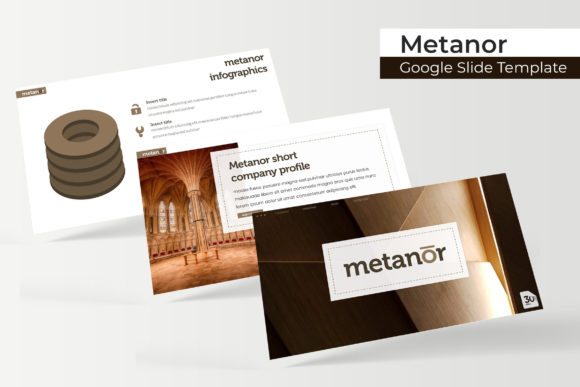
Creating a compelling presentation often feels like a balancing act between aesthetic appeal and clear communication. The Metanor Google Slide Template addresses this challenge by providing a comprehensive design framework that adapts to various professional and creative needs. Rather than offering a single rigid structure, this template system functions as a versatile toolkit containing 150 total slides distributed across five distinct premade color themes. With 30 unique slides allocated to each color variation, users gain access to a broad visual vocabulary without needing to build layouts from scratch. This depth of content makes it relevant for a wide spectrum of users, from students drafting their first capstone project to entrepreneurs pitching to venture capitalists.
Diverse Applications Across User Groups
The value of a presentation template is rarely universal; it shifts depending on who is using it and what they aim to achieve. For beginners or those less confident in graphic design, the primary benefit of Metanor is structure. The inclusion of handcrafted infographics and pre-arranged gallery slides removes the intimidation of the blank canvas. A student or entry-level employee can focus entirely on refining their narrative and data accuracy, trusting that the visual hierarchy is already established. The drag-and-drop functionality based on master slides ensures that even accidental edits do not break the overall layout integrity, providing a safe environment for learning presentation design principles.
Conversely, experienced professionals and marketers evaluate the template through the lens of efficiency and brand consistency. For these users, time is a critical resource. Having five PPTX widescreen files ready for immediate deployment means that recurring reports, client updates, or internal training sessions can be assembled in hours rather than days. The pixel-perfect illustrations serve as high-quality assets that maintain professionalism when projected on large screens or shared digitally. Experienced users also appreciate the section break slides, which allow them to organize complex information into digestible chapters, guiding stakeholders through dense material with visual cues that signal transitions.
Creatives, educators, and hobbyists often prioritize flexibility over speed. For this demographic, the Metanor Google Slide Template acts as a foundational layer that invites modification. Educators might use the portfolio slides to showcase student work or visualize historical timelines, while freelancers might adapt the gallery layouts to present case studies to prospective clients. Because the graphics are resizable and editable, these users can deconstruct the premade designs to create something entirely new. The template provides the raw materials—shapes, color palettes, and typographic pairings—that spark creativity rather than constrain it.
Evaluating Priorities: Quality, Flexibility, and Usability
When determining if this template aligns with specific goals, it helps to weigh different priorities against the features provided. Reliability and technical compatibility are paramount for business owners and corporate teams. The provision of five separate PPTX files ensures that each color theme remains isolated, preventing file bloat and reducing the risk of corruption during heavy editing. Furthermore, the inclusion of a readme file with free font download links eliminates the common frustration of missing typography, ensuring the presentation looks identical on every device. This attention to technical detail supports long-term usefulness, as the files remain functional assets for future projects.
For those focused on commercial value and cost-effectiveness, the volume of content offers significant return on investment. Acquiring 150 professionally designed slides across five aesthetics is generally more economical than hiring a designer for a custom deck or purchasing multiple single-theme templates. Small business owners operating on lean budgets can leverage this variety to test different visual identities or maintain distinct looks for different product lines without additional expense. The ability to switch between five premade colors allows for seasonal updates or audience-specific tailoring without requiring advanced color theory knowledge.
Ease of use remains a critical factor for consumers and non-designers. The distinction between standard slides and master slide-based elements is important here. While the template offers extensive customization, the core interaction model relies on intuitive picture placeholders. Users do not need to understand vector masking or layer management to update visuals; they simply drag an image into the designated frame. This lowers the barrier to entry significantly, allowing individuals with minimal technical skills to produce results that rival agency work. However, users seeking total artistic freedom should note that while the graphics are editable, they are structured within a specific design language that may require effort to radically alter.
Practical Implementation Examples
Understanding how different roles utilize these features clarifies the template's practical utility. Consider a freelance consultant preparing a quarterly market analysis. They might select the blue color variation to convey trust and stability, utilizing the handcrafted infographic slides to transform raw spreadsheet data into engaging visual charts. The section break slides help divide the presentation into methodology, findings, and recommendations, keeping the client engaged throughout the session. Because the template includes widescreen formatting, the consultant can confidently present via video conference without worrying about cropped edges or illegible text.
In an educational setting, a university lecturer might use the portfolio slide layouts to display art history comparisons or scientific diagrams. The resizable graphic elements allow them to emphasize specific details within a larger image, directing student attention precisely where needed. Since the photographs in the preview are not included, the educator must supply their own imagery, but the placeholder system ensures that any uploaded image maintains the correct aspect ratio and alignment. This saves valuable class preparation time and ensures that lecture materials look polished and organized semester after semester.
A startup founder creating a pitch deck faces different pressures. They need to establish credibility quickly while maintaining visual interest. By leveraging the pixel-perfect illustrations, they can explain abstract concepts like software architecture or user flows without resorting to cluttered screenshots. The availability of five color variations allows them to align the deck with their current branding guidelines instantly. If they pivot their messaging or rebrand before the next funding round, switching to a different color file takes minutes, preserving the structural work already completed.
Making the Right Choice for Your Project
Deciding whether the Metanor Google Slide Template matches your needs requires honest self-assessment regarding your skill level and project scope. If you require a highly specialized, bespoke design that defies conventional grid systems, this template may feel restrictive despite its editability. It is best suited for users who want professional standards applied efficiently rather than avant-garde experimentation. Additionally, because all preview photographs are for illustration purposes only, users must have access to their own high-quality images or stock photo subscriptions to fully realize the template’s potential. Those without visual assets may find the empty placeholders less inspiring until populated.
However, for the vast majority of presentation tasks, the combination of volume, quality, and usability makes this a robust solution. Beginners gain confidence through guided design; professionals gain speed through modularity; and creators gain inspiration through well-crafted components. The inclusion of essential support materials like font links and documentation demonstrates a commitment to user experience that extends beyond the slides themselves. Whether you are presenting financial results, teaching a workshop, or showcasing creative work, the template provides a reliable foundation that elevates content without overshadowing it. Ultimately, the decision rests on whether you value having a comprehensive, adaptable system that grows with your evolving presentation needs.